
Description
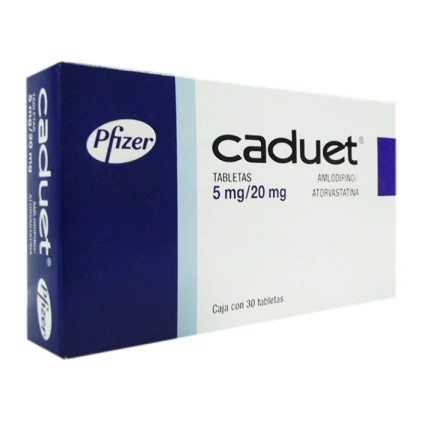
CADUET AMLODIPINE-ARTOVASTATIN 5/40MG
CADUET® (amlodipine / atorvastatin) is indicated in the following patient populations:
1. Patients with a higher cardiovascular risk due to the presence of two modifiable risk factors, hypertension and dyslipidemia; me
2. Patients with increased cardiovascular risk due to the presence of symptomatic CHD (coronary artery disease) expressed as angina with the additional modifiable risk factor of dyslipidemia; me
3. Prevention of cardiovascular complications in hypertensive patients (see Prevention of cardiovascular complications).
In patients with multiple cardiovascular risk factors, CADUET® (amlodipine / atorvastatin) is indicated for:
Hypertension: The amlodipine component is indicated for first-line treatment of hypertension and can be used as a single agent to control blood pressure in most patients.
Patients not adequately controlled with a single antihypertensive agent (other than amlodipine) may benefit from the addition of the amlodipine component of CADUET® (amlodipine / atorvastatin), just as they would benefit from the addition of amlodipine alone.
Amlodipine is also indicated to reduce the risk of fatal coronary heart disease and non-fatal myocardial infarction and to reduce the risk of stroke.
Coronary artery disease: The amlodipine component is indicated to reduce the risk of coronary revascularization procedures and the need for hospitalization for angina in patients with coronary artery disease.
Chronic stable angina: The amlodipine component is indicated for first-line treatment of myocardial ischemia, whether it is the cause of fixed obstruction (stable angina) and / or vasospasm / vasoconstriction (prinzmetal or variable angina) of the coronary vasculature.
CADUET® (amlodipine / atorvastatin) can be used when the clinical presentation suggests a possible vasospastic / vasoconstrictor component but it has not been confirmed that there is vasospasm / vasoconstruction.
CADUET® (amlodipine / atorvastatin) can be used alone or in combination with other antianginal drugs in patients with angina refractory to nitrates and / or adequate doses of ß-blockers.
Dyslipidemia: The atorvastatin component is indicated as an adjunct to the diet for the treatment of patients with elevated values of total cholesterol, LDL cholesterol, apolipoprotein B and triglycerides and to increase HDL cholesterol in patients with primary hypercholesterolemia (heterozygous hypercholesterolemia in familial and non-familial ) combined (mixed) hyperlipidemia (Fredrickson types IIa and IIb), high levels of serum triglycerides (Fredrickson type IV), and in patients with dysbetalipoproteinemia (Fredrickson type III) who do not respond adequately to diet.
The atorvastatin component is also indicated to reduce total cholesterol and LDL cholesterol in patients with homozygous familial hypercholesterolemia.
Prevention of cardiovascular complications:
In patients without clinically evident cardiovascular disease and with or without dyslipidemia but with multiple risk factors for coronary heart disease such as smoking, hypertension, low HDL-C diabetes or a family history of early coronary disease atorvastatin is indicated for:
– Reduce the risk of fatal coronary disease and non-fatal myocardial infarction.
– Reduce the risk of stroke.
– Reduce the risk of revascularization procedures and angina pectoris.
In patients with clinically evident heart disease atorvastatin is indicated for:
– Reduce the risk of non-fatal myocardial infarction.
– Reduce the risk of fatal and non-fatal stroke.
– Reduce the risk in revascularization procedures.
– Reduce the risk of hospitalization for congestive heart failure.
– Reduce the risk of angina.
Pediatric patients (10 to 17 years old): Atorvasta
Tina is indicated as a dietary adjunct to reduce total cholesterol, LDL-C, and apo B levels in boys and girls 10 to 17 years of age with heterozygous familial hypercholesterolaemia if the following observations are present after adequate trial with dietary therapy :
to. LDL-C remains ³ 190 mg / dL or
b. LDL-C remains ³ 160 mg / dL and:
• there is a positive family history of premature cardiovascular disease or
• Two more distinct CVD risk factors are present in the pediatric patient.

Reviews
There are no reviews yet.