
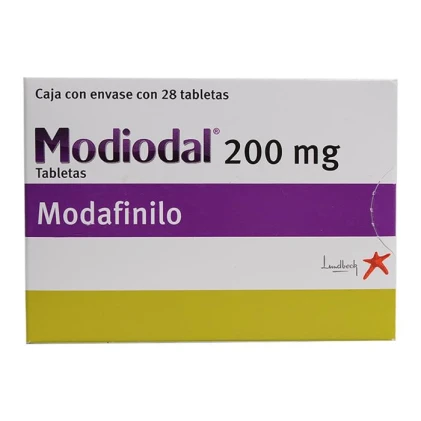
Description
PROVIGIL MODAFILIN 200MG 28 TABLETS
PHARMACOKINETICS AND PHARMACODYNAMICS: MODIODAL ® is a neurostimulant that promotes wakefulness and has a protective effect on cortical neurons from glutamate-induced degeneration.
MODIODAL ® (modafinil) is not chemically related to central nervous system (CNS) stimulants such as methylphenidate and amphetamine.
Pharmacokinetics:
Absorption: Modafinil is well absorbed after oral administration. The elimination half-life is between 9 and 14 hours after a single oral dose of 200 or 400 mg. Peak plasma concentrations of modafinil occur between 1 and 4 hours. Both modafinil and one of its pharmacologically inactive metabolites, modafinil acid, have linear pharmacokinetics over a dose range of 50-400 mg. The oral bioavailability of a 200 mg tablet compared to a micronized aqueous suspension is approximately 100%. Following multiple doses of 200, 400, and 600 mg modafinil daily, apparent steady-state plasma concentrations were achieved after 2-4 days of dosing. The mean steady-state peak and trough plasma concentrations following single oral doses of 200 mg daily are approximately 6 and 2 μg/ml, respectively. The respective values following a single daily oral dose of 400 mg are approximately 11 and 3 μg/ml. The elimination half-life following the last dose of the multiple-dose regimen is 13 to 18 hours. Although enzyme induction has not been definitively established in clinical studies, it has been observed at higher doses in preclinical studies. Stereospecific pharmacokinetics of the modafinil enantiomers have been demonstrated. The d-enantiomer is eliminated faster (100-140 ml/min) than /-Modafinil (35-50 ml/min).
Distribution and Protein Binding: Modafinil is moderately bound to plasma proteins (61-65%), essentially to albumin.
Modafinil does not change the binding characteristics of warfarin, diazepam or propranolol at therapeutic concentrations, suggesting little or no interaction with these three drugs based on the lack of displacement of protein binding by modafinil in vitro . Plasma protein binding is not affected by modafinil acid. Plasma concentrations of modafinil and modafinil acid after administration of 200 or 400 mg modafinil are not affected by warfarin protein binding. Modafinil is widely distributed (approximately 60 l/kg or 0.8-0.9 l/kg) as evidenced by a volume of distribution greater than the total volume of water in the body (0.6 l/kg).
Metabolism and Elimination:Modafinil is extensively metabolized after oral dosing by deamination, oxidation and hydroxylation of the aromatic ring and is excreted primarily in the urine as metabolites (at least 60% of the dose). The total clearance of modafinil after a single oral dose is approximately 60 mL/min. Less than 10% of the dose is excreted in the urine in parent form, with a renal elimination rate of approximately 3 mL/min, suggesting that hepatic metabolism is the primary route of elimination. The majority of the dose is excreted in the urine as modafinil acid. The remainder of the dose excreted in the urine appears as side chain cleavage products at the sulfur atom, small amounts of modafinil ring-hydroxylated acid and its glucuronide, and trace amounts of modafinil sulfone and modafinil acid sulfone. After a single dose of 14C modafinil in the side chain administered to 6 healthy subjects, 80% and 1% of the dose was recovered in urine and feces, respectively, over an 11-day period.
Pharmacodynamics: The precise mechanisms by which modafinil stimulates wakefulness are unknown. However, it is presumed to be a dose-dependent inhibitor of GABA-ergic neuron activity in the cerebral cortex and nucleus accumbens, both in the sleep-related brain areas and in the medial preoptic area and posterior hypothalamus. Its effect is stimulating the CNS, excitatory of the wakefulness system of the brain stem and cortex.
Unlike classical stimulants, modafinil has a different neurochemical profile, with minimal effects on the peripheral nervous system, with low abuse potential and does not appear to produce tolerance.
In contrast to amphetamine, modafinil is not an anorexigenic and produces only a mild stereotypic effect at doses 8 to 10 times greater than those required to increase wakefulness or locomotor activity. Modafinil-induced wakefulness is not inhibited by the dopamine receptor antagonist haloperidol. Unlike amphetamine, modafinil increases lucidity without rebound during non-rapid eye movement (NREM) sleep.
The optical enantiomers of modafinil have pharmacological actions similar to those of modafinil.
Two major metabolites of modafinil, modafinil acid and modafinil sulfone, do not appear to contribute to modafinil’s CNS-activating properties.
Food Effect: Although food delays the absorption of modafinil, the amount absorbed and the rate of elimination are no different in the fasted state than in the fed state.
Age/sex effects:The pharmacokinetics of modafinil are minimally affected by gender. The effect of age on pharmacokinetics has been studied in young and older male subjects. The clearance rate of modafinil in male subjects decreases slightly (approximately 10-20%) with increasing age.
Renal Disease: Plasma levels of modafinil are similar between healthy volunteers and patients with renal impairment. In a study in patients with renal impairment (creatinine clearance 5-20 ml/min) the elimination of modafinil acid was reduced. Only 25% of the dose was excreted in urine as modafinil acid in patients with renal impairment. In contrast, 45% of the modafinil dose was excreted as modafinil acid in urine in healthy subjects.
Liver Disease: In an 8-day multiple-dose study (twice daily, 100 mg at 8 am and noon) in patients with liver cirrhosis, plasma levels and elimination half-lives in hepatically impaired patients were twice those found in normal subjects, suggesting that the major route of elimination for modafinil is through the liver.
Clinical Studies: The efficacy of MODIODAL ® in reducing excessive daytime sleepiness (EDS) associated with narcolepsy was established in two multicenter, placebo-controlled, parallel-group, double-blind studies in outpatients who met ICD-9 and American Sleep Disorders Association criteria for narcolepsy, which are consistent with American Psychiatric Association DSM-IV criteria.


Reviews
There are no reviews yet.